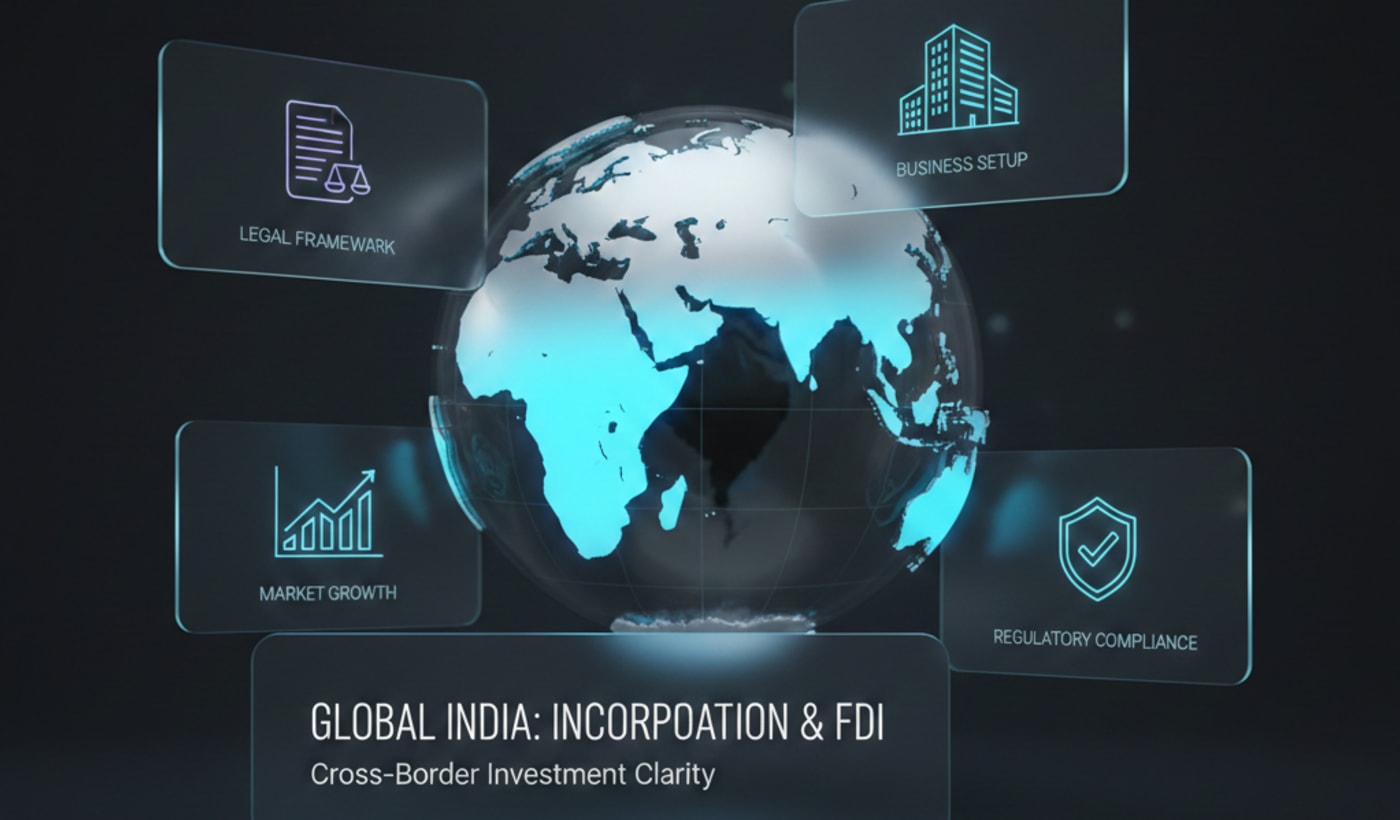
Company Incorporation in India and Foreign Investment (FDI Route): A Complete 2026 Guide for Global Entrepreneurs
India has emerged as one of the most attractive destinations for entrepreneurs, startups, multinational corporations, and global investors. With a rapidly expanding economy, strong regulatory reforms, and increasing digitalization, company incorporation in India and investment through the Foreign Direct Investment (FDI) route have become streamlined and investor-friendly.
If you are planning to start a business in India or invest in an Indian entity, understanding the legal framework under the Companies Act, 2013 and the FDI regime under the Foreign Exchange Management Act, 1999 (FEMA) is critical.
This comprehensive guide explains company registration in India, available structures, FDI routes, compliance requirements, and strategic considerations for foreign investors.
Understanding Company Incorporation in India
Company incorporation in India refers to the legal process of registering a business entity under the Companies Act, 2013 with the Ministry of Corporate Affairs (MCA). Once incorporated, a company becomes a separate legal entity distinct from its shareholders.
India offers multiple business structures, but for foreign investors and scalable businesses, the most preferred structure is a Private Limited Company. It provides limited liability protection, easier fundraising options, and better credibility in the market.
The incorporation process today is largely digital and completed through the SPICe+ integrated system on the MCA portal. It includes name approval, incorporation, PAN, TAN, GST registration (if applicable), and other statutory registrations in a single workflow.
For startups, technology ventures, consulting firms, manufacturing units, and cross-border businesses, incorporating a Private Limited Company ensures flexibility in issuing equity shares, preference shares, compulsorily convertible debentures, and other instruments permitted under FEMA regulations.
Key Legal Framework Governing Foreign Investment in India
Foreign investment into India is governed primarily by FEMA, 1999 along with the Consolidated FDI Policy issued by the Government of India. FEMA regulates capital account transactions and ensures that foreign exchange inflows comply with India’s macroeconomic and regulatory objectives.
FDI can be made under two primary routes:
- Automatic Route – No prior government approval is required. The investor only needs to comply with sectoral caps and reporting requirements.
- Government Approval Route – Prior approval from the concerned ministry or department is required before investment.
Most sectors in India are now under the automatic route, making India one of the most liberal FDI regimes among major economies.
What is the Automatic Route under FDI?
Under the automatic route, foreign investors can invest in sectors such as IT services, manufacturing, consulting, wholesale trading, and many other industries without prior approval. However, post-investment compliance is mandatory.
After receiving foreign investment, the company must:
- Issue shares within 60 days of receiving funds.
- File Form FC-GPR on the RBI’s FIRMS portal within the prescribed timeline.
- Ensure pricing guidelines and valuation norms are followed.
- Comply with sectoral caps and conditions.
Non-compliance can attract penalties under FEMA, which makes professional structuring and compliance advisory extremely important.
What is the Government Route under FDI?
Certain sectors such as defense, telecom (in specific thresholds), and sensitive industries may require government approval before accepting foreign investment.
In such cases, the proposal is submitted through the Foreign Investment Facilitation Portal (FIFP), and approval is granted after inter-ministerial consultation.
Investors must evaluate whether their proposed activity falls under the automatic route or government route before structuring the transaction.
Types of Instruments Allowed under FDI
Foreign investors can invest through various capital instruments such as:
- Equity Shares
- Compulsorily Convertible Preference Shares (CCPS)
- Compulsorily Convertible Debentures (CCD)
Non-convertible instruments are generally treated as external commercial borrowings (ECB) rather than FDI and are governed by separate regulations.
Strategic structuring becomes crucial when dealing with valuation, exit rights, put options, downstream investments, and transfer pricing implications.
Pricing Guidelines and Valuation under FEMA
When shares are issued to a foreign investor, the pricing must comply with RBI guidelines. For unlisted companies, valuation must be determined as per internationally accepted pricing methodology certified by a Chartered Accountant or SEBI-registered Merchant Banker.
This is particularly important in startup funding, cross-border joint ventures, and strategic foreign collaborations. Incorrect valuation can trigger FEMA violations and tax exposure.
Sectoral Caps and Conditionalities
India allows 100% FDI in many sectors such as manufacturing and IT services. However, certain sectors have caps or specific conditions attached.
Before accepting foreign investment, businesses must carefully review sectoral caps, downstream investment rules, and whether any performance-linked conditions apply.
Post-Incorporation and Ongoing Compliance
Company incorporation is only the beginning. Once a company receives foreign investment, it must comply with:
- Annual filings with the MCA
- FEMA reporting requirements
- Transfer pricing regulations (if cross-border transactions exist)
- Income tax and GST compliance
- Beneficial ownership disclosures
For multinational structures, issues such as international taxation, DTAA benefits, transfer pricing documentation, and repatriation planning must be addressed at the structuring stage.
Why Strategic Structuring Matters in FDI Transactions
Foreign investment is not just about bringing capital into India. It is about structuring entry, profit repatriation, exit mechanisms, share transfers, royalty arrangements, and cross-border tax optimization.
Poor structuring can result in:
- FEMA penalties
- Tax disallowances
- Transfer pricing adjustments
- Regulatory scrutiny
- Exit restrictions
A 360-degree approach integrating corporate law, FEMA, international taxation, transfer pricing, and GST ensures that transactions remain regulator-resilient and audit-ready.
How India is Becoming a Global Investment Hub
With progressive reforms, digital incorporation systems, startup incentives, production-linked incentives (PLI), and ease of doing business measures, India continues to attract global investors.
Foreign companies looking to establish a subsidiary in India or invest in an existing Indian entity must align legal structuring with commercial objectives. Whether it is a wholly owned subsidiary, joint venture, or strategic minority investment, compliance and structuring determine long-term success.
Final Thoughts
Company incorporation in India combined with investment through the FDI route offers immense opportunity for global entrepreneurs and investors. However, the regulatory landscape under the Companies Act, 2013 and FEMA requires careful planning and technical precision.
If you are considering incorporating a company in India or structuring foreign investment into an Indian entity, it is essential to evaluate sectoral eligibility, structuring options, valuation norms, and reporting requirements before proceeding.
India offers opportunity. Strategic structuring ensures sustainability.